Monday, August 18, 2014

How to get yourself kicked off of Pinterest

I work with a guy who is an Apple fanatic.  He owns the latest Apple everything, pretty much when it comes out.  He tracks the latest Apple trends.

"Last night, as me and my wife were watching a movie from my Mac through my Apple TV, I read the funniest thing on my MacBook Air."

"It was... Oh hang on, I'm getting a text on my iPhone."

"Did you know that the next iPhone will be built with Gorilla Glass?"

Another guy that I work with has the nickname "Gadget Guy".  He's not married to any one company, but he buys all of the cool toys. Like mosquito bite lasers and car mounted deer scaring air warblers. His office is equipped with a digital picture frame and a tablet that he uses to read books on at lunch time.

"Mosquitos were a problem at the cottage.  So then I installed a surround-sound mosquito repelling frequency emitter.  It's thought powered."

And then there's me, the late adopter of everything.

I never got a Facebook account, or a MySpace one when that was big.  I'm not on Twitter.  When I finally relented and got a cell phone two years ago, I got a cheap little pay-as-you go plan with a correspondingly cheap phone.

It doesn't text very well, its pictures are of terrible quality and it has no app for that.  It is, however, inexpensive.

I'm a Millennial, but when people talk about how technology and social-media savvy Millennials are... well, I must have missed the memo.

"Wait, come back!  This is really important stuff!"

Two years ago, I joined the latest social media craze - Pinterest.  Two months later, my Pinterest account was locked.

This is my story.

It is quite possible, given the rapid rise and fall of various social media sites, that in a few years, someone will be reading this and be all, "What's Pinterest?"

That person will have been born in 2020 and be reading the blog from the cyborg implant in their arm.
So, for that cyborg child, here is a description of Pinterest.

"Pinterest is a company that provides an Internet service that they describe as a visual discovery tool. People use Pinterest to collect ideas for projects and interests. Users create and share collections (called “boards”) of visual bookmarks (called “Pins”) that they use to do things like plan trips, develop projects, organize events or save articles and recipes."

In practise, it looks a lot like this:

OMG Events!

OMG Crafts!

OMG Food!

I got a Pinterest account a few years ago, on the advice of a co-worker.

What on earth would I use Pinterest for, I asked her.  She used Pinterest to do crafty things like design costumes for her kids and to plan super-fancy theme birthday parties.

For many years, I hadn't needed Pinterest to help me with my sewing projects.  I failed to start needing Pinterest to help with my sewing projects once I had Pinterest.

"If only I could look at the amazing project of someone more talented than me.  That would make me feel better about my own work." --Not said by me ever.

I looked elsewhere for my PINspiration.

Ha ha ha!  So original!  This is not a pun that has probably ever been used before!!!

So what else did people make boards of?  My first board featured pictures of things that I thought looked like fun.  Three days and twenty or so posted pictures later, the exercise felt self-indulgent; I got bored.

"OMG Space travel! ... I'm really reaching, aren't I?"

Pinterest niggled at me, though.  I felt like I needed to do something meaningful with it.  If this was to be my contribution to the great social network of the world, I wanted it to have oomph.

You know what is meaningful and contributes to the world?

I bet you weren't going to say stocks.

Traitors.

I decided to make a Pinterest page on stocks.  Specifically, dividend stocks.  Extra specifically, those dividend stocks that are listed in the Dividend Champions list.

Feel free to commence mocking me.  What can I say?  I like my stocks.

I didn't just stop there.  Oh no, if I was going to do a page on Stocks to Consider, I would analyze the heck out of those stocks.  I used the four questions of Derek Foster.

1 - Is it recession proof?
2 - Is it dominant in its industry?
3 - Does it have a long history of strong performance?
4 - Does it have a strong consumer brand loyalty?

(For the uninitiated, "Yes" is the right answer to all of the above questions.  To buy a stock, you would have a confident yes answer to all four questions.)

I started at the top of the alphabet.  On the first day, I pinned pictures representative of 3 companies and my analyses of those companies.


Three days later, I went to add the fourth stock to the super awesome board.  That's when I found out that my account was locked.

Pinterest had apparently found my board and decided that my pins were too commercial.  I had, in their opinion, violated their terms of service.

I was crushed.  For a full week, I mournfully checked every day to see if my password had started working again.

"Maybe?"

For a full week, my password continued to not work.

"No."
The following week, I pulled the tattered shreds of my life together and proceeded to ignore Pinterest.

"I can live without you, Pinterest."
Like a spurned ex-boyfriend, Pinterest didn't ignore me.

"What do you mean, you can live without me?"

Pinterest never deleted my account.  My Stocks to Consider page lives on.  Pinterest still sends me emails about all of the people who "re-pin" my pins... like it is something about which I should care deeply.

"Love meeeeeee..."

Could things have been different?  Could I have found a way to make a board about finance that wouldn't have gotten me kicked off of the website?  I'll never know.

Now I shun Pinterest and blog instead.  That is, until Blogger spurns me somehow.  Stay tuned!

Monday, August 4, 2014

Not a satisfying finance article

This week, I told myself: "I need to stay focused, to finish drawing the pictures to complete my next post."

Instead, I read this article: http://www.cracked.com/blog/8-totally-free-games-to-kick-your-boredoms-ass/ 

Then, I started playing Paladog, a totally free online game.

As promised by the article, it totally kicked my boredom's butt.  It also helfully deleted all of that pesky free time that I might have spent actually working on my post.

Fortunately, just this morning the game stopped working on my computer.  I will not be doing anything to try fix this problem.  Instead, I will work hard on the article, and hopefully will have something fun ready in two weeks.

Thanks for stopping by.

Monday, July 21, 2014

What's on Top of my Finance News Feed?

Let's read some financial news.  I picked the top article off of my financial news feed.

The article to be discussed: this one.
Wall St rebounds from selloff; indexes up for the week
Technology stocks ranked among the day's biggest gainers. Google led the rally. Its stock jumped 4.2 percent to USD 605.11 a day after the No. 1 Internet search company reported second-quarter results that beat investors' expectations.
Numbers and percentages and stuff!  This is an article for the crème de la crème, the real investor types!!!


The article reads like a laundry list of statistics for the: S&P 500, Google, Facebook, Dow Jones, Nasdaq, CBOE volatility index, Russel 2000... 


Sorry, I just nodded off there for a moment.

To save you, dear reader from having to read the article, here is a Q&A with... myself.


What does this article tell me?

The stock market fell on Thursday, before rising on Friday.  Some stocks did particularly well, other stocks fell precipitously.  World events happened, but failed to affect the stock market in any lasting way.  Depending on which collection of stocks an investor had picked on Monday, that investor might have gained or lost money on Friday.

So, basically this article doesn't tell me anything.

What do you mean, doesn't tell you anything?  By reading this article, you learned that:
Market participants kept geopolitical news in focus. US President Barack Obama demanded that Russia stop supporting separatists in eastern Ukraine a day after the downing of a Malaysian airline by a surface-to-air missile, which he said was fired from rebel territory. The incident raised the prospect of more US sanctions on Moscow. 
Investors also remained cautious after Israel warned on Friday that it could "significantly widen" a Gaza land offensive.
What the heck does that mean?

Well, it means that people who invest also read the news.  It also means that to save time, the writer of this article copied the major weekly headlines and added a little market spin.  Here: I'll show you how it's done.

Market participants kept geopolitical news in focus...

Gosh, golly.  It's hard to keep focus, the little tyke is moving so quickly!
Investors remain cautious after...
I'd be cautious, too, but only if I was alone in a room with him.
I read market news to help me invest.  What benefit does this article have for me, the investor?

Do you also have a time machine?  Because if you did, this article would tell you that you should, on July 14th 2014, definitely buy: Google, Facebook and Honeywell International.  That same day, you should sell any of your General Electric Shares.

I don't have a time machine, obviously.

Oh... That's problematic.

Well, have no fear!  The article also gives you some rock-solid guidance for the future:
"It seems counter-intuitive, given the ruthlessness with which the market sold off yesterday, but in the broader context, the markets are generating a lot of attractive themes," said Peter Kenny, chief market strategist at Clearpool Group in New York. 
"We have an economy that is expanding," he added. "We have many data points that support that narrative. We are in the middle of earnings season, and earnings season has given investors reason to believe that what we have seen in the headlines over the last day or two, though very important, isn't what is driving investment decisions."
What does that mean?

It means that you shouldn't pay attention to the news.  When you buy shares of a company, you should pay attention to whether that company is actually earning any money.

That's... pretty decent advice, actually.

I suppose.  So what stocks should I buy?

Now you're talking!  You should, apparently, buy stocks with good earnings.  

Which stocks are those?  

The article is very clear on that point.
S&P 500 companies' profits are expected to grow 5 percent in the second quarter, according to Thomson Reuters data, down from the 8.4 percent growth forecast at the start of April. Revenue is seen up 3.2 percent.
Basically, this article tells you that you should buy all of the S&P 500.

I'm an individual investor.  I can't afford to buy shares in all of the 500 stocks on the S&P 500.

Oh, then this article thinks that you should buy mutual funds.

The whole article boils down to an endorsement of mutual funds?

Yes.

That's kind of useless.

I couldn't agree with you more.

Monday, July 7, 2014

Debt-mas 2010

A few years ago at Christmas time, money was tight.


My house was continuing to be its spectacularly needy self, I'd just bought a new-to-me car (and snow tires for that new car and a new alternator for the old car which wasn't yet sold) and it was, well, Christmas.  

Christmas was to be a family affair, that year at a rented house near Barrie, Ontario.  My mother, retired, left early so she could gobble up as much adorable time with her grand-baby as possible.  

"My, what pretty teeth you have, grandmother."
My dad and I, employed, left Christmas Eve for the long southerly drive.  We took my new car, its virgin cross-provincial trip.

Because it was my car, we barely even listened to talk radio.
We made it to the gas station in Napanee where I filled the car.  Oddly, the machine wouldn't allow me to pay outside; thinking nothing of it, I went inside.


I'm pretty sure that a dictionary definition of awkwardness is standing in a gas station two and a half hours from home on the phone with your credit card company asking why they will not let you pay for the $20 of gasoline that you just finished putting in your car.


The reason?  My card was compromised.  The credit card company was going to mail a new credit card to my house, scheduled to arrive in the second week of January when their office wasn't on holiday anymore.  None of this was useful to the person who was headed away from her house and who would have great need of the card over that period of time to do holiday things, like skiing and filling my car with gas.

They gave me one glimmer of hope: I could use the card if I used the chip feature and typed in the pass code.  

At the time, the chip feature was brand new to Canada.  Only the newest machines accepted them.  The odds were not in my favour.

We finally made it to the destination and, worries pushed aside but not forgotten, I Christmased the snot out of Christmas.


Unfortunately for me, the city that we stayed in was small and did not have the most up-to-date technology.

"We've got the thingie, but it's not activated yet."

"What in the heck is that chip for?"

"Oh no, we don't take credit."

I still paid for things, but these things were paid for with my Interac card, the money drawing directly from my bank account.

This was a problem.  Because of all the circumstances surrounding that particular moment in time, I was scraping the bottom of the financial barrel.  My plan for paying off my credit card included not only the money that I had in my bank account, but also the money that I would earn from my pay cheque.


I should note that this plan was not a good plan.  It was a terrible, no-good plan that I would recommend to no one (though it was slightly better than not paying my credit card bill at all).  The horrible plan hinged on my continued access to that credit card.  Without it, my finances started to look more like this:


When faced with what seemed at the time like insurmountable odds, I did what any reasonable person might do; I appealed to a higher power.

"Hello, customer service.  ...hello?"
After hearing my tale of woe, the company agreed that I could defer my payment of my credit card bill.  To keep my credit rating intact, they advised me to pay the absurdly low minimum payment.  They promised me that I would be charged no interest.

If this were an epic story, then there would be a twist at this point.  They didn't just agree to do something and then actually DO it, did they?

Which segues into the story of how I turned to drug running to pay off my credit card debt... allegedly.
I was lucky; it rolled out exactly as they promised.

I'm sorry.  It's just how I am.

From this experience, I was able to learn for free an important lesson about credit cards: don't charge more than you have in the bank.  

There are much more expensive ways to learn this lesson.  Please note that I don't advise any of them.

Monday, June 23, 2014

Investment Choices: Part 1, Interest

I'll have you all know that this is one of the first posts that I set out to write.  It's been shelved time and time again, for the simple reason that I haven't been able to figure out how to introduce the topic.

There are two ways to get money: earn it by working for it; or earn it by using it to make more of it.  Investment is the second one.

A large rabbit, surrounded by zillions of smaller rabbits.
If money were rabbits, investment would be easy.

That's pretty broad statement, and basically means that everything could be an investment.

An infographic: "Locate fertile farmland" leads to "Buy farmland, equipment, seeds ($$$$$$)" leads to "Add time" leads to "add labour" leads to "harvest crops" leads to "sell crops, profit ($$)" which closes the loop.

An infographic: "Come up with business idea" leads to " Develop, test, evaluate, research, pitch, fund idea ($$$$)" leads to "PROFIT!!! (Hopefully) ($$$$$$$$$$$$...)"

An infographic: "Identify valuable thing(s)" leads to "buy thing for low price ($$$)" leads to "add time" leads to "add effort" leads to "sell thing for higher price ($$$$)"

My plan, the plan that I'd been working on for months, was to define and describe all of the different investment mechanisms that I could think of.  A quick search of the internet revealed that other people already wrote definitions of investment mechanisms.  You can find a few choice examples here, here and here.  

Giving financial definitions isn't really my specialty, anyways.  I'm better at stories.  Today I will tell you a story about interest.

***

My mom had a limited patience for picture books, particularly if she had to read them.  

me, my mom and my sister sitting together on a bed.  My mom is reading a story and looks annoyed.
"One fish, two fish, red fish, f*** this."

As a result, by the time I was 7 or so, bedtime stories for me and my older sister involved a wide selection of books that an adult could find interesting.  We read the entire collection of Calvin and Hobbes, we read Beverly Cleary, we read For Better or For Worse.  On one notable occasion, we read "A Wrinkle in Time" by Madeline L'Engle and I understood none of it.

Me, my mom and my sister sitting on a bed.  My mom now looks happy reading the story.  I look unconvinced.
“Qui plussait, plus se tait. French, you know. The more a man knows, the less he talks.” 

Me, my mom and my sister sitting on a bed.  My mom now looks happy reading the story.  I look bored.
“You mean you're comparing our lives to a sonnet? A strict form, but freedom within it? Yes. Mrs. Whatsit said. You're given the form, but you have to write the sonnet yourself. What you say is completely up to you.” 

My mom, my sister and I could all agree on the Little House Series, by Laura Ingalls Wilder.  It is a curious thing as a kid imagining that people older than you might have ever been kids themselves.

A picture of 70-year-old Laura Ingalls Wilder's head pasted on a cartoon body carrying a teddy bear.  The picture is in sepia tones.
Maybe.  But probably they only saw in black and white.

'Farmer Boy' is a book about Laura Ingalls-Wilder's husband's childhood.  Reading it, it's hard to miss that money is a theme.

Take for example this description of Almanzo's father:

"Almanzo's father was an important man.  He had a good farm.  He drove the best horses in that country.  His word was as good as his bond, and every year he put money in the bank."

Cartoon mimicking the "American Gothic" painting, only the farmers are wearing bling and the man is carrying a wad of money.
"He was a man of the soil, if by soil you mean money."

Later in the book, Almanzo receives a $200 reward for finding and returning some really rich guy's wallet.

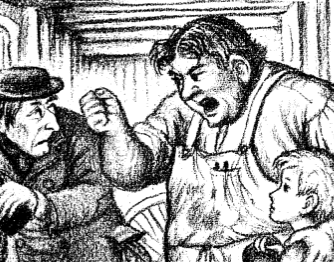
A fragment of the picture from the book.  A scrooge-like man is cringing away from a burly man who is shaking his fist and holding the shoulder of  Almanzo.
Pictured: the rich guy (left) willingly giving a reward to kind young Almanzo.

Almanzo's father takes 9-year-old Almanzo to the bank to deposit the $200, whereupon he spends a few paragraphs rhapsodizing on the wonders of the interest that Almanzo will earn on this investment. 

Almanzo, holding his father's hand and a wad of money.  His father looks happy and is talking.
"Because you'll have $200 in the bank, they'll pay you interest each year.  At 5%, that's $10 in the first year."
Almanzo, holding his father's hand and a wad of money.  His father looks happy and is talking.
"In the second year, that's $10.50."
Almanzo, holding his father's hand and a wad of money.  His father looks happy and is talking.  Almanzo now looks bored.
"...and after 10 years, supposing the interest rate stays the same and that you don't deposit anything further, you'll have $325.77!"

The book is very specific; but alas, I don't own the book anymore and the internet isn't giving me the answers that I need.  Let's say he earned 5% (based on this source)

At 11, I wondered how much money Almanzo could have expected to earn on his investment in the long term.  I pulled out my calculator and started multiplying.  I wanted to know when his investment would double. 

Me looking intense, writing out each year's interest earnings on a sheet of paper.


There are two ways to calculate interest, depending on whether the interest is simple and compounding.

Simple interest uses simple math:

The formula for simple interest, with my calculation showing that it would take 20 years to double the money.

Compounding interest uses complicated math:

The formula for compound interest, with my calculation showing that it would take 14.2 years to double the money.
This isn't how I did my calculations when I was 9.  One physics degree later, I have a few more tools in the mathematical tool kit.
Using either calculation, young Almanzo would have needed to wait for decades to turn his money into anything approaching a retirement fund.  


After my analysis, I was left wondering if interest was a good way to earn money in the long term.  I decided then--and in this era of sub 1% interest rates am even more convinced--that leaving money in a bank account is not a good investment.