Monday, June 23, 2014

Investment Choices: Part 1, Interest

I'll have you all know that this is one of the first posts that I set out to write.  It's been shelved time and time again, for the simple reason that I haven't been able to figure out how to introduce the topic.

There are two ways to get money: earn it by working for it; or earn it by using it to make more of it.  Investment is the second one.

A large rabbit, surrounded by zillions of smaller rabbits.
If money were rabbits, investment would be easy.

That's pretty broad statement, and basically means that everything could be an investment.

An infographic: "Locate fertile farmland" leads to "Buy farmland, equipment, seeds ($$$$$$)" leads to "Add time" leads to "add labour" leads to "harvest crops" leads to "sell crops, profit ($$)" which closes the loop.

An infographic: "Come up with business idea" leads to " Develop, test, evaluate, research, pitch, fund idea ($$$$)" leads to "PROFIT!!! (Hopefully) ($$$$$$$$$$$$...)"

An infographic: "Identify valuable thing(s)" leads to "buy thing for low price ($$$)" leads to "add time" leads to "add effort" leads to "sell thing for higher price ($$$$)"

My plan, the plan that I'd been working on for months, was to define and describe all of the different investment mechanisms that I could think of.  A quick search of the internet revealed that other people already wrote definitions of investment mechanisms.  You can find a few choice examples here, here and here.  

Giving financial definitions isn't really my specialty, anyways.  I'm better at stories.  Today I will tell you a story about interest.

***

My mom had a limited patience for picture books, particularly if she had to read them.  

me, my mom and my sister sitting together on a bed.  My mom is reading a story and looks annoyed.
"One fish, two fish, red fish, f*** this."

As a result, by the time I was 7 or so, bedtime stories for me and my older sister involved a wide selection of books that an adult could find interesting.  We read the entire collection of Calvin and Hobbes, we read Beverly Cleary, we read For Better or For Worse.  On one notable occasion, we read "A Wrinkle in Time" by Madeline L'Engle and I understood none of it.

Me, my mom and my sister sitting on a bed.  My mom now looks happy reading the story.  I look unconvinced.
“Qui plussait, plus se tait. French, you know. The more a man knows, the less he talks.” 

Me, my mom and my sister sitting on a bed.  My mom now looks happy reading the story.  I look bored.
“You mean you're comparing our lives to a sonnet? A strict form, but freedom within it? Yes. Mrs. Whatsit said. You're given the form, but you have to write the sonnet yourself. What you say is completely up to you.” 

My mom, my sister and I could all agree on the Little House Series, by Laura Ingalls Wilder.  It is a curious thing as a kid imagining that people older than you might have ever been kids themselves.

A picture of 70-year-old Laura Ingalls Wilder's head pasted on a cartoon body carrying a teddy bear.  The picture is in sepia tones.
Maybe.  But probably they only saw in black and white.

'Farmer Boy' is a book about Laura Ingalls-Wilder's husband's childhood.  Reading it, it's hard to miss that money is a theme.

Take for example this description of Almanzo's father:

"Almanzo's father was an important man.  He had a good farm.  He drove the best horses in that country.  His word was as good as his bond, and every year he put money in the bank."

Cartoon mimicking the "American Gothic" painting, only the farmers are wearing bling and the man is carrying a wad of money.
"He was a man of the soil, if by soil you mean money."

Later in the book, Almanzo receives a $200 reward for finding and returning some really rich guy's wallet.
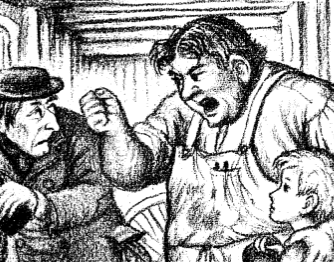
A fragment of the picture from the book.  A scrooge-like man is cringing away from a burly man who is shaking his fist and holding the shoulder of  Almanzo.
Pictured: the rich guy (left) willingly giving a reward to kind young Almanzo.

Almanzo's father takes 9-year-old Almanzo to the bank to deposit the $200, whereupon he spends a few paragraphs rhapsodizing on the wonders of the interest that Almanzo will earn on this investment. 

Almanzo, holding his father's hand and a wad of money.  His father looks happy and is talking.
"Because you'll have $200 in the bank, they'll pay you interest each year.  At 5%, that's $10 in the first year."
Almanzo, holding his father's hand and a wad of money.  His father looks happy and is talking.
"In the second year, that's $10.50."
Almanzo, holding his father's hand and a wad of money.  His father looks happy and is talking.  Almanzo now looks bored.
"...and after 10 years, supposing the interest rate stays the same and that you don't deposit anything further, you'll have $325.77!"

The book is very specific; but alas, I don't own the book anymore and the internet isn't giving me the answers that I need.  Let's say he earned 5% (based on this source)

At 11, I wondered how much money Almanzo could have expected to earn on his investment in the long term.  I pulled out my calculator and started multiplying.  I wanted to know when his investment would double. 

Me looking intense, writing out each year's interest earnings on a sheet of paper.


There are two ways to calculate interest, depending on whether the interest is simple and compounding.

Simple interest uses simple math:

The formula for simple interest, with my calculation showing that it would take 20 years to double the money.

Compounding interest uses complicated math:

The formula for compound interest, with my calculation showing that it would take 14.2 years to double the money.
This isn't how I did my calculations when I was 9.  One physics degree later, I have a few more tools in the mathematical tool kit.
Using either calculation, young Almanzo would have needed to wait for decades to turn his money into anything approaching a retirement fund.  


After my analysis, I was left wondering if interest was a good way to earn money in the long term.  I decided then--and in this era of sub 1% interest rates am even more convinced--that leaving money in a bank account is not a good investment.

Monday, June 9, 2014

Trend Analysis, Illness Edition

Last winter, my sister and her husband drove the four hours that it takes them to come visit me.  They brought along their two daughters, Laryngitis and Virus*. (*names have been changed)

Me holding what looks like a baby, but is shaped like a virus, standing beside a small child with a virus head.   We're standing in front of a Christmas tree.  I'm smiling.
Shortly after this touching Christmas scene, my throat decided that it hated breathing.

We had a blast.

I roughhoused with L, my oldest niece, until her bedtime.


I'm holding my niece by the ankles, while she smiles and waves her arms.
"More! Achoo!" - L
We all took turns diverting V from her mission to chew on all of the power cords in my basement.


My sister chases after my niece V, who has her eyes on her father's laptop cable.  Her father is sitting and working on his computer.  I am protecting the stairs and my friend is protecting the television and game system.
"Nom nom nom.  Hack, Cough." -V

Finally, we went out on Sunday to play in the cold winter snow at Winterlude.


"Whee!  Snuffle, wheeze." - L

Shortly after they left on the Sunday, I felt a tickle in my throat.  Illness is almost guaranteed after I spend time with family.  We're good at sharing.


Me, looking concerned in the direction of my throat, which is labelled: "Pain".


"I'll just take a cold pill to kick it," I thought to myself.  I popped two Buckley's day pills and then went to sleep.

I woke up Monday, sick, and went to work.


Me, in my work clothes, looking tired and rumpled.


Tuesday morning I was still sick, also cranky; I went to work.


Me, in my work clothes, looking tired, rumpled and angry.
I was a joy to be around.

Wednesday morning I still sick, also hideously disgusting; I oozed to work.


Me, in my work clothes, looking tired, rumpled, angry and my nose is dribbling a green goo.

The previous picture is covered with a green splatter marking.  In the middle is written: "ACHOO!"
Where I proceeded to repaint the office.

By Thursday, I had enough of being sick and disgusting at work, so I stayed home.  
Me lying in my bed, covered completely with a blanket.

When I woke up later in the day, I realized that something was different.


I shuffled to the bathroom and peeled my crusted, disgusting eye open to reveal that the devil had taken up residence in my left eyeball.


A close-up of my face.  My now opened left eye is bright red.


"It'll pass," I assured myself.  I find that this approach works well for most illness.

To pass the time, I updated my stocks spreadsheet.  It did not help the devil eye, which got redder and more itchy as the day progressed.  


The same close-up of my face, only now the skin around my red eye is pink.


When my eye didn't miraculously heal itself as I had hoped it would, I turned my attention to the medical world.  My optometrist was kind enough to let me pay her money to glance briefly at my eye, chuckle and write me a prescription.  


Me sitting hunched in a chair at the optometrist's office, holding a tissue to my dribbling nose.  Beside me stands a person in a white coat who is staring at a clip board.
"My experience says that infection this is usually fatal.  Just kidding.  Take some eye drops."
Then, she and her receptionist shuffled me out the door and burned anything that I had touched.


Me walking away from a burning building.  You can still see the building's sign that says: "Eye Dr."
"It's the only way to prevent the spread."

Here is where the worlds of my illness and your interest in reading about finance intersect.  Entering the pharmacy to fill my prescription and stock up on cough drops, I noticed that the shelves had been decimated.  Their supply of cough drops was at a precipitous low.  


Me standing in a store aisle, with only a scattering of boxes on the shelves.  At the end of the aisle, a tumbleweed blows.


All their non-prescription medication had been stripped away, leaving only the gross flavours.


Me staring, unimpressed, at two different cough drop flavours: "Lard" and "Pine Cone"
"Cough drops flavoured with all natural ingredients."

Empty cough drop shelves at the pharmacy can mean only one thing: a death plague.  I looked to the internet to validate my experience.  I expected something dramatic.  


A weather map from a huge snow storm, re-purposed.  The lower end is labelled: "Light Coughing", the upper end is labelled "Unprecedented death Plague"


The internet didn't validate my expectations.  According to all traditional sources, the cold season was spreading exactly as much misery as it usually did, but no more.


A microscope image of a cold virus, with a face drawn on it.
"What, you expect me to overachieve?"

There was one shining beacon of hope: an article that stated that Google estimated, based on an increased quantity of searches on terms relating to illness, that more people than usual were getting a cold.  They postulated that this probably meant that the cold season this year was worse than usual.


The following sentences, arranged to make the word: "ILL".  "Sore throat fix"; "Why do I feel so sh*tty?"; "Runny nose"; "get vomit out of rugs"; "How to stop my kid's high fever"; "im coughing a lot do I have cancer?" "Phlegm in throat"


Feel free to question the scientific and journalistic accuracy of such an article.  I know I didn't; instead I felt justified, like I had just unraveled some great mystery.  I was a visionary, a noticer of great trends.  


Me standing proudly at the top of a rocky hill, blue sky in the background, holding a flag that reads: "Best Investor"


This isn't the type of website where I tell you that I used that knowledge and bought XYZ pharmaceuticals company which gave me a 1000% return in the last 6 months.  I instead filed the information in my brain and proceeded to buy shares in two different telecommunications companies.

This kind of thing, noticing subtle trends and then using those trends to get an investing edge, is an investment strategy that many people use to good effect.  Of course, your data has to be accurate for the strategy to work; it turned out that the increased search data didn't correlate to the actual US sickness rates.

A good investor is curious, interested and calm.  I made my prediction, tried to substantiate it and then watched as I was proven wrong.  I learned from my experience.

To you the reader, I pass the challenge.  Try to find patterns in things.  When you think that you've found a pattern, look it up and see if it's been substantiated anywhere.  If it hasn't been substantiated, it doesn't necessarily mean that you're wrong; maybe no one has noticed yet.  Try to imagine how you could use your knowledge of that pattern to make money.

Then--and this is only my advice--let it go.  Don't act on the first idea you ever have.  Wait and watch and see who does act on it, see how they do.  Cultivate your ability to notice things.

Maybe one day, you'll be the one bragging about your 1000% return.  You never know.


A person with a blank face standing proudly at the top of a rocky hill, blue sky in the background, holding a flag that reads: "Best Investor"


(Full disclosure: I currently own JNJ and ABBV, both of which sell pharmaceuticals.  I didn't, however, buy them after my fever-driven inquiry.)

*** 

Note: I edited the first part of the story and removed the first picture; on rereading, I wondered if it seemed a bit mean-spirited to my nieces, who are two of my favorite little humans.  Then my sister and my mother both said to put it back, so I did.

Monday, May 26, 2014

Taxes, Just Another Savings Account

I don't have a lot of spending money.

Don't feel bad for me; I'm doing fine.

I don't have a lot spending money, and it's by design.  By design, I mean that I have almost 10 different chequing and savings accounts between which I partition my money and only one of them has an Interac Card.

Four envelopes stuffed with money labelled: "Vacation", "Reno", "Tax", "Car"
Bank accounts: the new money envelope
The Wealthy Barber advises that you pay yourself first, "yourself" meaning your retirement savings.  I pay myself first, but I also pay my house repairs, my future car, my vacations and my education first.  I have an account that exists just for my property taxes.

Me on a bench looking at a pair of shiny new shoes, thinking: "Hmm... Is there enough money in the shoe fund?"
I'm not this bad.

Do I drown in bank fees?  No, I don't pay any bank fees.  One account requires a minimum balance, which I keep.  The others are all free.

In my main account, where I get my spending money from, I keep very little money.  We won't quibble about exact numbers, but once I'm done squirreling money away, I get to "keep" about 5% of my take home pay, after taxes.

And by "keep" I mean use it for things like new clothes or books or gadgets.

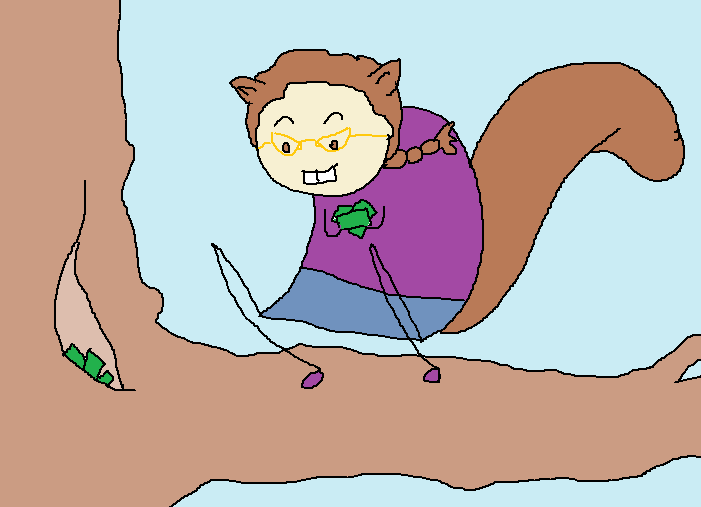
Me, looking like a squirrel, hiding money in a knot in a tree.
Or hiding in convenient cubby holes, for winter.

I arbitrarily don't have a lot of spending money and it works well.

When I had a mortgage, about half of my take-home pay went to paying it off.  (A note:  My house isn't so expensive that I had to pay this much; I just wanted the debt paid off.)  An automatic transfer deducted the money after each pay day from my main account and placed it in a mortgage savings account, where the mortgage payments were automatically deducted.  I never saw that money again.

A picture of me standing in front of my house, waving to my money as it flies away and saying: "Farewell, money.  Fly free!"
Except, you know, I got to keep the house.  So it wasn't exactly gone.

Which brings me to taxes.  I'm from Canada, and we are purported to have a very high tax rate relative to other countries.  The exact number of that rate is hard to pin down - I briefly checked two sources, and they quoted different percentages.  Let's break it down.

I pay income taxes to both the provincial and federal governments.  The taxes are bracketed, meaning that chunks of my earnings are taxed at different, ascending rates.  Those tables can be found from my most favorite Canadian tax website, for those who are interested.

Me, hunched over under a heavy weight labelled: "Taxes", that is sitting on my head.
It gives no advice on how to cure tax pain.

I also pay sales tax on nearly everything that I buy to both the provincial and federal governments.  A few years ago, the Ontario government teamed up with the federal government and 'Harmonized' their sales taxes.  It means that I pay more taxes, but only see one line item on my bill.  Harmony!

Two identical faced singers standing back to back, singing: "Sales Tax!" in unison.  One is wearing a green jacket with the Ontario Trillium insignia, the other is wearing a Red jacket with the Maple Leaf insignia.
But it's nice to see them playing well with each other.

That number, in Ontario, is 13% - it varies by province and sometimes by city (Montreal, for example tacks on an additional 1%)

Finally, I pay property taxes on my house.  Even if I rented, I would still be paying this via my landlord, who would account for this fee in my rent rate.  How property taxes are calculated remains a mystery to me, probably relating in some way to horoscopes and numerology.

I am looking skeptically at a person in a gaudy wizard costume who is gazing into a crystal ball with an intense expression.
"Let's see, the house aligns with the axis of light on the third rotation of the moon.  It's also near a high school.  $3750 per year."

So the real amount that any person pays in taxes in Canada is relative to how much stuff they buy and how big their house is taken together with how much money they actually earn.

While the number varies from person to person, the sentiment generally doesn't.  Nobody likes taxes.  Filing taxes is not anyone's idea of a fun time.

I am wearing a slightly sad face.
What the face of a taxed person might look like.

People's reactions vary, but thus far I've managed to resist the urge to run away from civilization and build a sovereign commune in the wilderness.

Me, sitting curled up in a dark space.  Around me is: toilet paper, gold bars, cans, useless weapons (sai) and a can opener.   I am muttering: "...No one takeses my gold.... No one takeseses my cans..."
They'd probably try to tax the commune's land and then things might get awkward.

Instead, taxes are a background noise that I ignore.

It might sound really pompous when I say it that way.  "Taxes are just background noise.  It's really hard to notice them over the jet engines on my yacht."

Me inside a boat-like thing with jet engines.  I am surrounded by stars in space.
My SPACE yacht.

Except that doesn't even make sense - taxes don't make any noise.

An envelope labelled 'taxes' sits on a table.  It is shaking and making a noise: "Skritch skrtch krtchh".  I am standing across the room, facing away, holding a box labelled "box o' stuff".  I am looking over my shoulder with a concerned expression.
Except when you least expect it.
I have a job, which deducts my taxes at the source.   Their standard calculations suck, as they assumed that I had a all manner of bouncing baby tax deductions that I do not have.

Cartoon babies
Cartoon babies: not tax deductible.
Me giving a present to my older niece, while my younger niece smiles and looks adorable.
Holiday presents for my nieces: not tax deductible.

I was routinely paying a lot of extra taxes at tax season.

Me, frowning.
Last year.

How do taxes become background noise? Last year, I told the finance people to deduct extra money from my paycheck for taxes.  After a full year, the tax deductions did what they were supposed to do.  I could enjoy tax season because it meant that I got a refund.

Me, smiling broadly and waving my arms in the air.  Money is falling like rain around me.
This year.

Of course, there are detractors to this method, who rightly point out that extra money that you pay to the government is held interest free.  Any money you get as a tax deduction could have been sitting in your bank account or your brokerage, earning you returns.

There is one thing that these people neglect to include in their calculations, and that is human nature.  My tax return was in the ballpark of $1500.  This number is a bit ridiculous, but it takes into account a few unexpected things that I did this year, like earn less money and deposit some money into my RRSP.

Broken down over 26 pay periods, I paid an extra $57 to the government on each paycheck, money that I could have been investing that money or, more likely, spending it on all the random stuff that I spend my money on.  Maybe a few dinners out, maybe a pair of pants.

Me sitting on a chair looking at shiny shoes.  I'm smiling and thinking: "Of course there's enough money!"
"I like them so much, I'll buy five."
At the end of the year, I sure wouldn't have had that money sitting around to pay taxes.

Taxes, like dentistry, are a necessary part of life.  Like dentistry, taxes are best when they are painless.  It's hard to resent the government when they're giving you money, even if it's your money that they're just returning to you.

So in one way, taxes are like an automatic savings program.  In another way they're better.  Sometimes they give money back to you.

Monday, May 12, 2014

Taxes - the introduction

Spring is reluctantly springing.

A smiling sun saying: "Summer is coming!" next to a frowning tree with crossed twig arms saying: "Go away.  I am NOT ready to get up." next to a  frosty wind saying: "OK :)"
Biorhythms.

In Canada, spring means two things: allergies and taxes.

And the start of a unique time of year when temperatures are consistently above freezing.
Canadian taxes are usually due by the end of April.  This year, the Heartbleed virus hit the CRA's (Canada Revenue Agency, for the uninitiated) net-file website, so Canadians were given an extra 10 days to file their taxes.

The CRA, I presume, felt that this was sensitive information and did not post it on their website.

A crouching figure saying: "No one shall know" and clutching a sheet of paper.


Armed without that knowledge, I returned from a sleepless weekend out of town and filed my taxes on what I thought was the last day of tax season.

Me sitting in front of my desk with forms all around me and bags under my eyes saying: "Gnnnmggh"
I filed them thoroughly and accurately, for anyone who is keeping track.
It took me about three hours, consistent with last year's time.  Are you asleep yet?  Stay with me.

When I told one of my coworkers that I was starting a blog on finance, she got very excited.  She said: "Great, you can do topical posts.  March is coming up, so you can do some articles on taxes!"

Taxes!

My coworker is taking a series of university courses to become a chartered accountant.  She knows more about Canadian taxation laws then I ever will.  It was inspiring to see how much faith she had in my ability to write useful and succinct things about a topic as obscure as taxation.

Fortunately, I don't have to.  I get all of my information on Canadian taxation from a single website.  Do you have any kind of a question about Canadian taxes?  The only answers I know are here.

I bet you didn't come here to learn factual information about Canadian taxation.  I've got more to say on the subject, especially when it comes to the taxes of someone who has active finances.

Over the years of trying out different ways of investing and using and earning my money, I have turned my taxes from the standard person's type three numbers and claim some deductions style taxes into a marathon of data entry and a personal competition to see how many different forms I can invoke.

That's what I'll talk about next time.  See, I've run out of time.

Thanks again for all your patience.  See you in two weeks!
Me, waving goodbye.