Showing posts with label book review. Show all posts

Monday, October 6, 2014

Stop Working, Here’s How You Can! by Derek Foster

In one of my frequent self-improvement-driven efforts, this summer I took a drama class at a local drama school. My goal was to improve my stage presence to the point that I would stop this unpleasant habit that I've had all my life of shrinking into a blob of quivering goo whenever anyone pays too much attention to me.

"I asked her how her day was going."

I guess you could say that the class was a success:  by the end of the session I dredged up enough self-confidence to consider attending the school’s one-year anniversary meet-and-greet function. The word function here is deserving of italics because it’s something that I’m sure posh people do.

And I am clearly a master of blending in with posh people.

Having arrived, I promptly curled up into a tiny ball of quivering goo when nobody at all paid attention to me.

"Who's that?"
"I have no idea."

Progress!

When quivering failed to score me any meaningful social interaction, I unrolled myself and actually talked to some people from my class. I knew that I had found the right people to talk to when I mentioned that I wrote a finance blog and both of their eyes lit up.

"You love investing?  We love it, too!"

“So what’s your investing style?” they asked.

If I’d wanted to actually be posh, I would have answered with highly specific and technical words: dividend investing with a mixture of growth and value stocks.

Instead, what I said was: “Well, I started out by reading all of Derek Foster’s books...”

You’ll notice that the narration trails off there. That is because I trailed off at that point when one of my conversation partners recoiled as if I had just smacked him across the face with a soiled diaper.

"...and I select stocks based on my daily horoscope."

It turns out that my new friends were not fans of Derek Foster.

***

I've taught the controversy; onto the subject.

Stop Working, Here's How You Can! is a good book.  I'll start with that.  It's a interesting, fast read.  It tries very hard to make investing accessible to a person with no investing knowledge.  Most books do the opposite.  They tell you that investing is horrifying and scary and should only be done by people with decades of training.

...and even those people need to wear protective suits.

Derek Foster has written a number of books. It was his first book that I read in University, and that I credit with starting me on the path to putting my money into stocks.

Derek Foster is a personal investor turned investment writer, who credits his investment decisions with allowing him to no longer require a day job by the time that he was 34.

His first book is titled: “Stop Work: Here’s How You Can”

Actually, I think I already know how to not work.

I think I read the book when I was 20. This matters, because it’s very disheartening to read a book on the subject of retiring from the “rat race” at 34 when you are older than 34 and still in the rat race. At
20, the book is motivational.
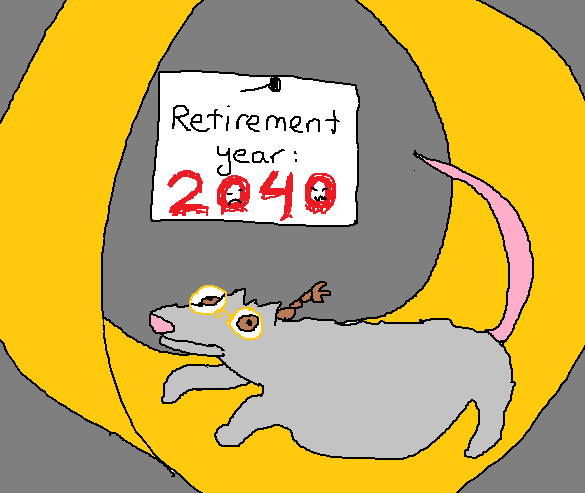
"2040 is not a year that can possibly ever exist... There must be another way."

How does one retire at 34? One follows Derek Foster’s idiot-proof* plan.

*Note the use of “idiot”, used here because Derek Foster now calls himself the “Idiot Millionaire”, rather than “That guy who retired at 34”. This is because, as many people have subsequently pointed out, he didn't retire at 34. He took a sabbatical and wrote a best-selling finance book at 34, which has somewhat different implications financially.

A subtle difference, I'm sure.
The plan is:

1 – Spend very little money.
2 – Invest the money that you don’t spend into recession-proof dividend-paying stocks of companies that you buy cheaply and then never sell.
3 – Repeat.

This is good advice. It’s the kind of good advice that a parent gives their children, so that the children don’t repeat all of the mistakes that the parents have made.

"Come give me a hug and promise that you will get your university degree in one of the STEM fields.  It's where the money is."

You won't get rich quickly by following his advice.  Even Derek Foster himself didn't follow his own advice.  He used the kinds of methods that many investors use, such as:

- Repeatedly selling off all of his holdings to buy the latest big thing.
- Borrowing on margin to buy stock.
- Selling his stock when the market tanks, famously during the big recession.

Here I go, teaching the controversy again.  If you want to read more, there are other people who can do a better job, here and here.  Ripping Derek Foster apart isn't the point of my review.

It's a good book.  I like it.  I recommend it to friends.

You should read Stop Working, Here's How You Can! if you want:
- An easy-to-read summary of the major market sectors in Canada and some timeless stocks
- References to other interesting books and websites and resources.
- A really good explanation of why dividend stocks are awesome
They're like apple trees!
SWHHYC (a clunky acronym for a clunky title) sells a dream: financial independence; a pension plan for those who don't have one; freedom from work and the whims of the stock market on a given day.

Is the dream wrong?  No.

I endorse both money and retirement.

Could the method be used successfully to attain this dream?  Yes, but not in the time frame that he promises, and not without some very careful lifestyle design.

VERY careful.  (Source)
Do I recommend this book?  Yes.  Believe his personal stories with a grain of salt and enjoy the read.

Monday, June 23, 2014

Investment Choices: Part 1, Interest

I'll have you all know that this is one of the first posts that I set out to write.  It's been shelved time and time again, for the simple reason that I haven't been able to figure out how to introduce the topic.

There are two ways to get money: earn it by working for it; or earn it by using it to make more of it.  Investment is the second one.

A large rabbit, surrounded by zillions of smaller rabbits.
If money were rabbits, investment would be easy.

That's pretty broad statement, and basically means that everything could be an investment.

An infographic: "Locate fertile farmland" leads to "Buy farmland, equipment, seeds ($$$$$$)" leads to "Add time" leads to "add labour" leads to "harvest crops" leads to "sell crops, profit ($$)" which closes the loop.

An infographic: "Come up with business idea" leads to " Develop, test, evaluate, research, pitch, fund idea ($$$$)" leads to "PROFIT!!! (Hopefully) ($$$$$$$$$$$$...)"

An infographic: "Identify valuable thing(s)" leads to "buy thing for low price ($$$)" leads to "add time" leads to "add effort" leads to "sell thing for higher price ($$$$)"

My plan, the plan that I'd been working on for months, was to define and describe all of the different investment mechanisms that I could think of.  A quick search of the internet revealed that other people already wrote definitions of investment mechanisms.  You can find a few choice examples here, here and here.  

Giving financial definitions isn't really my specialty, anyways.  I'm better at stories.  Today I will tell you a story about interest.

***

My mom had a limited patience for picture books, particularly if she had to read them.  

me, my mom and my sister sitting together on a bed.  My mom is reading a story and looks annoyed.
"One fish, two fish, red fish, f*** this."

As a result, by the time I was 7 or so, bedtime stories for me and my older sister involved a wide selection of books that an adult could find interesting.  We read the entire collection of Calvin and Hobbes, we read Beverly Cleary, we read For Better or For Worse.  On one notable occasion, we read "A Wrinkle in Time" by Madeline L'Engle and I understood none of it.

Me, my mom and my sister sitting on a bed.  My mom now looks happy reading the story.  I look unconvinced.
“Qui plussait, plus se tait. French, you know. The more a man knows, the less he talks.” 

Me, my mom and my sister sitting on a bed.  My mom now looks happy reading the story.  I look bored.
“You mean you're comparing our lives to a sonnet? A strict form, but freedom within it? Yes. Mrs. Whatsit said. You're given the form, but you have to write the sonnet yourself. What you say is completely up to you.” 

My mom, my sister and I could all agree on the Little House Series, by Laura Ingalls Wilder.  It is a curious thing as a kid imagining that people older than you might have ever been kids themselves.

A picture of 70-year-old Laura Ingalls Wilder's head pasted on a cartoon body carrying a teddy bear.  The picture is in sepia tones.
Maybe.  But probably they only saw in black and white.

'Farmer Boy' is a book about Laura Ingalls-Wilder's husband's childhood.  Reading it, it's hard to miss that money is a theme.

Take for example this description of Almanzo's father:

"Almanzo's father was an important man.  He had a good farm.  He drove the best horses in that country.  His word was as good as his bond, and every year he put money in the bank."

Cartoon mimicking the "American Gothic" painting, only the farmers are wearing bling and the man is carrying a wad of money.
"He was a man of the soil, if by soil you mean money."

Later in the book, Almanzo receives a $200 reward for finding and returning some really rich guy's wallet.

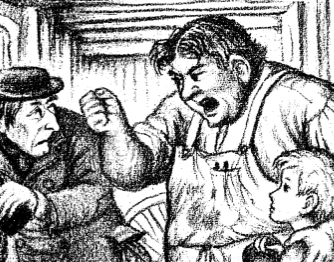
A fragment of the picture from the book.  A scrooge-like man is cringing away from a burly man who is shaking his fist and holding the shoulder of  Almanzo.
Pictured: the rich guy (left) willingly giving a reward to kind young Almanzo.

Almanzo's father takes 9-year-old Almanzo to the bank to deposit the $200, whereupon he spends a few paragraphs rhapsodizing on the wonders of the interest that Almanzo will earn on this investment. 

Almanzo, holding his father's hand and a wad of money.  His father looks happy and is talking.
"Because you'll have $200 in the bank, they'll pay you interest each year.  At 5%, that's $10 in the first year."
Almanzo, holding his father's hand and a wad of money.  His father looks happy and is talking.
"In the second year, that's $10.50."
Almanzo, holding his father's hand and a wad of money.  His father looks happy and is talking.  Almanzo now looks bored.
"...and after 10 years, supposing the interest rate stays the same and that you don't deposit anything further, you'll have $325.77!"

The book is very specific; but alas, I don't own the book anymore and the internet isn't giving me the answers that I need.  Let's say he earned 5% (based on this source)

At 11, I wondered how much money Almanzo could have expected to earn on his investment in the long term.  I pulled out my calculator and started multiplying.  I wanted to know when his investment would double. 

Me looking intense, writing out each year's interest earnings on a sheet of paper.


There are two ways to calculate interest, depending on whether the interest is simple and compounding.

Simple interest uses simple math:

The formula for simple interest, with my calculation showing that it would take 20 years to double the money.

Compounding interest uses complicated math:

The formula for compound interest, with my calculation showing that it would take 14.2 years to double the money.
This isn't how I did my calculations when I was 9.  One physics degree later, I have a few more tools in the mathematical tool kit.
Using either calculation, young Almanzo would have needed to wait for decades to turn his money into anything approaching a retirement fund.  


After my analysis, I was left wondering if interest was a good way to earn money in the long term.  I decided then--and in this era of sub 1% interest rates am even more convinced--that leaving money in a bank account is not a good investment.

Monday, February 10, 2014

Let's Talk about Investment Books - The Wealthy Barber


The cover page of the Book "The Wealthy Barber"

"So one month, when the stock market is really struggling and your mutual fund is [stocks are] suffering accordingly, don't look at the situation and say, 'Darn, my holding is down.'  Look at it and say, 'Eventually the market will go up and take the value of my holding with it, so in the meantime I'm going to pick up shares at a good price.'  Dollar cost averaging is great stuff!" 
--David Chilton, The Wealthy Barber.
(modifications by me, because I don't like mutual funds) 

The Wealthy Barber by David Chilton holds a special place in my life as the first book on Finance that I ever read.

It's a Canadian book, one that I don't think has really left the country.  Finance books don't travel well between different countries, because taxes and investment tools vary so much.  So, I should probably mention at this juncture that I'm Canadian.  I hope we can still be friends, everyone else.

The book is old, written sometime in the 80's, when a conservative estimate of interest rates was 10%.  Reading it, as I did early in the 2000's, I decided that the author was pretty much crazy, which coloured my view of the rest of his investment advice.

The book is written about a fictional barber who is wealthy.  He is wealthy because he saved money, 10% of his after-tax money to be exact, to have 'fun' in retirement.  "Retirement" as described by the wealthy barber is sort of a misnomer, the barber in the story wasn't yet retired.  He spills his wisdom only when the protagonists agree to pay him to cut their hair.


A scribble of three people standing together: woman, barber and man, getting his hair cut.  The barber says: "Yes kids, if you work hard and save your money, one day you too can retire.  Just like me!"

Same scribble, but now the woman says to the barber: "You aren't retired, Ray.  You still run 'Ray's barber shop' and appear to be its sole employee."  Ray looks sheepish.
The same scribble, but now the woman looks pensive and the barber says: "I can quit whenever I want to.  Stop judging my choices."

But! I am making it sound like I hated the book.  I did not; I like this book a lot.

I've never read a better summary of the psychology of tricking yourself into savings.  He says that you should "pay yourself first" - meaning, have an automatic deduction that gets withdrawn the same day as your paycheque hits the bank that goes directly to your savings.  He recommends that you pick a number (10% or higher) to start off your savings with and then... just do it.  He says that after a while, you'll adjust to your new reality, and the savings won't even seem like a burden.


It's so true... just ask the zillion other books that say exactly the same thing.  This one's really good, though.

He also does some interesting talking about math (dollar cost averaging, share values, interest rate calculations)... the kinds of things that really bring out the engineer inside of me.

At this juncture, I should probably mention that I'm an engineer.  I hope we can be friends, everyone else.

The author (through our friend the barber) also specifically cautions against trying to do your own investment.  Why?  Because it's hard.  Instead, he outlines a very complicated strategy of looking at past money management returns to make sure that these returns will continue into the future.  In his sequel, he comes to his senses and informs the world that this advice was wrong.  But investment is still too hard, guys.  So you shouldn't do it.

I ignore that part.  I also ignore his chapter on insurance.  It's really boring.  If you feel a gaping insurance-related void in your life, maybe read it.  If you're young and looking to start on investing, it's completely pointless.

For me, this is where it began.  I started saving ten percent of my money.  I just didn't put it anywhere, because I really didn't like the idea of mutual funds... it just didn't jell with my unconscious vision.

Yes, engineers have unconscious visions.  They involve math... and spreadsheets.

***

 You must realize that "Let's Talk Investing" is not authored by a financial planner, adviser, or a professional investor in any capacity. As such, this is not expert advice in legal, taxation, financial, or any type of information that may be provided. The reader must realize this when reading these articles and must not rely on them as the ultimate source of information but must seek proper verification from the appropriate professionals before acting on any of this information.